Business Strategy6 min read

Machine learning vs deep learning: which does your business actually need?
ZK
Zack KhanMay 5, 2026
Machine learning vs deep learning: which does your business actually need?
Machine LearningDeep LearningBusiness ROIData Science

Every week, a new headline proclaims the latest AI breakthrough. For business leaders trying to make informed technology investments, the noise can be overwhelming. Two terms dominate the conversation — Machine Learning (ML) and Deep Learning (DL) — but which one does your business actually need? The answer is not as straightforward as vendors would have you believe.

Machine Learning: The Proven Workhorse

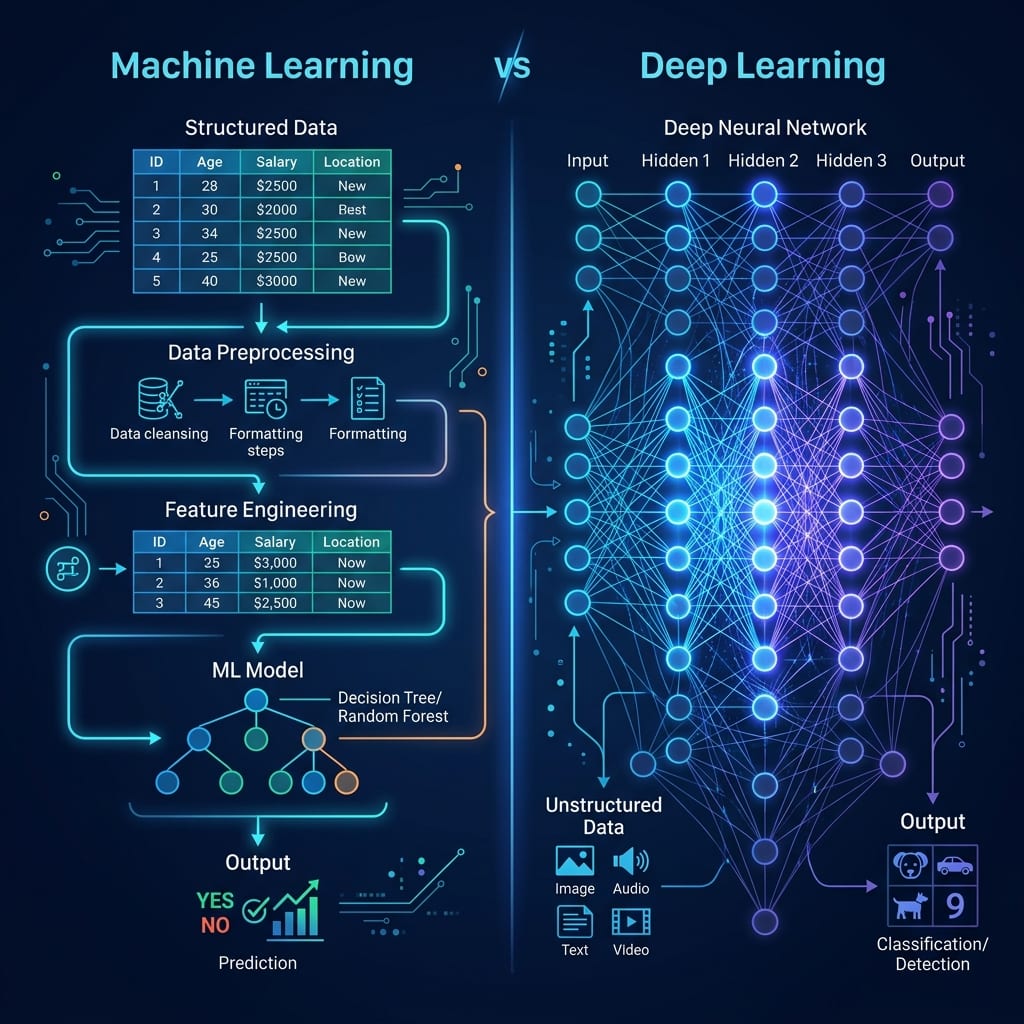
Machine Learning encompasses a broad family of algorithms that learn patterns from data without being explicitly programmed. Think of it as teaching a computer to recognize patterns by showing it thousands of examples. Traditional ML models include decision trees, random forests, support vector machines, and gradient boosting frameworks like XGBoost and LightGBM.

These models are remarkably effective for structured, tabular data — the kind that lives in your CRM, ERP, and financial systems. Predicting customer churn, forecasting demand, scoring leads, detecting fraud — these are all problems where traditional ML consistently outperforms deep learning, especially when your dataset is measured in thousands or tens of thousands of rows rather than millions.

  • Works well with structured/tabular data (spreadsheets, databases)
  • Requires less data — often effective with 1,000-50,000 examples
  • Highly interpretable — you can explain why a prediction was made
  • Fast to train — minutes to hours, not days
  • Lower infrastructure cost — runs on standard servers without GPUs

Deep Learning: The Unstructured Data Specialist

Deep Learning is a subset of ML that uses neural networks with many layers (hence 'deep') to automatically learn hierarchical representations from raw data. It is the technology behind image recognition, natural language processing, speech synthesis, and generative AI. If your problem involves images, text, audio, or video, deep learning is almost certainly the right choice.

The trade-offs are significant, however. Deep learning models are data-hungry — they typically need hundreds of thousands to millions of examples to train effectively. They require expensive GPU infrastructure (a single NVIDIA H100 costs over $30,000). They are notoriously difficult to interpret — explaining why a neural network made a specific prediction is an active area of research. And they take much longer to train and fine-tune.

  • Excels at unstructured data — images, text, audio, video
  • Requires large datasets — typically 100K+ examples for custom models
  • Computationally expensive — requires GPU/TPU infrastructure
  • Harder to interpret — often treated as 'black box' models
  • State-of-the-art performance — powers ChatGPT, DALL-E, and AlphaFold

A Decision Framework for Business Leaders

The decision between ML and DL should be driven by four factors: your data type, your data volume, your interpretability requirements, and your budget. If you are working with structured data and need explainable predictions (think credit scoring or medical diagnostics), traditional ML is your best bet. If you are processing images, documents, or natural language at scale, deep learning is the clear winner.

text
DECISION MATRIX

┌─────────────────────┬──────────────────┬──────────────────┐
│ Factor              │ Choose ML        │ Choose DL        │
├─────────────────────┼──────────────────┼──────────────────┤
│ Data Type           │ Structured/Table │ Images/Text/Audio│
│ Data Volume         │ 1K - 100K rows   │ 100K+ examples   │
│ Interpretability    │ Required         │ Not critical     │
│ Budget              │ Limited          │ Flexible         │
│ Time to Production  │ Weeks            │ Months           │
│ Infrastructure      │ CPU servers      │ GPU clusters     │
└─────────────────────┴──────────────────┴──────────────────┘

The Hybrid Approach: Best of Both Worlds

In practice, most enterprise AI systems use both. A typical e-commerce platform might use deep learning for product image classification and natural language search, while using gradient boosting for demand forecasting, pricing optimization, and fraud detection. The key is matching the tool to the problem, not chasing the latest trend.

Our Recommendation

Start with traditional ML. It is faster to deploy, cheaper to run, easier to debug, and often delivers 80-90% of the performance you need. Graduate to deep learning only when your specific use case demands it — typically when dealing with unstructured data at scale or when pre-trained foundation models (like GPT-4 or Claude) can be fine-tuned for your domain. This pragmatic approach maximizes ROI while minimizing risk.

Need help implementing these solutions?

Our team of experts can help you scale your technology and drive digital transformation. Explore our services to see how we can partner together.


Share this article

Start a Project
Chat with us!